
Search Engine Optimization (SEO) has changed dramatically over the last few years. Businesses that once ranked easily with keyword stuffing and backlinks are now struggling to stay visible in search results. Google’s algorithms have become smarter, AI-powered search experiences are growing, and user behavior continues to evolve.
This raises an important question:
Is traditional SEO still effective, or has modern SEO completely replaced it?
The answer is not as simple as choosing one over the other. In reality, successful websites today combine the strengths of both traditional and modern SEO strategies.
In this guide, we will explain the difference between traditional SEO and modern SEO, what has changed in 2026, and how businesses can adapt their strategies for long-term search visibility.
What Is Traditional SEO?
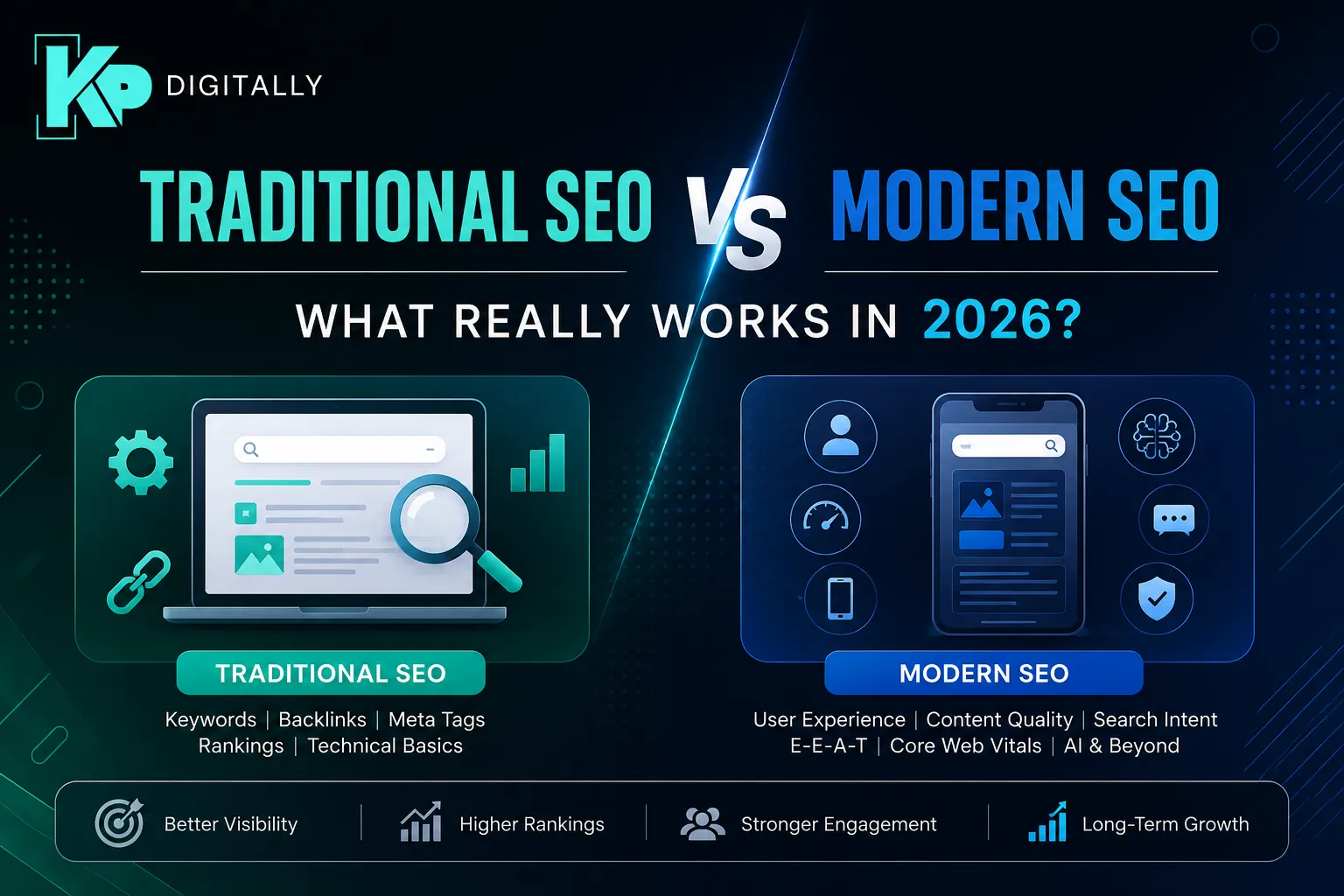
Traditional SEO refers to the older optimization methods primarily focused on improving rankings in search engines through technical signals and keyword targeting.
Earlier SEO strategies mainly focused on:
- Exact-match keywords
- Meta tags optimization
- Link building
- Directory submissions
- Keyword density
- Basic on-page SEO
- Ranking-focused content creation
The main goal of traditional SEO was simple:
Rank higher on Google search results pages.
For many years, this approach worked well because search engines relied heavily on keywords and backlinks to understand webpage relevance.
What Is Modern SEO?
Modern SEO focuses more on users than search engines alone. Instead of only optimizing for rankings, modern SEO aims to create high-quality experiences that genuinely help people.
Modern SEO includes:
- Helpful and original content
- Search intent optimization
- User experience (UX)
- Core Web Vitals
- Mobile-first performance
- E-E-A-T (Experience, Expertise, Authority, Trust)
- AI search visibility
- Semantic SEO
- Structured data
- Voice search optimization
- Content depth and topical authority
Today, Google uses artificial intelligence and machine learning to better understand content quality, user behavior, and context.
That means websites must now focus on solving real user problems instead of simply targeting keywords.
Traditional SEO vs Modern SEO: Key Differences
1. Keyword Stuffing vs Search Intent
Traditional SEO
Older SEO methods focused heavily on repeating keywords multiple times throughout a page.
Example:
“Best digital marketing agency in Ahmedabad” repeated excessively.
Modern SEO
Modern SEO focuses on understanding what users actually want when they search.
Instead of keyword repetition, Google now prefers:
- Natural language
- Topic relevance
- Helpful answers
- Semantic context
Search intent matters more than keyword density.
2. Quantity of Content vs Quality of Content
Traditional SEO
Many websites published large amounts of low-quality or duplicated content just to target more keywords.
Modern SEO
Google now prioritizes:
- Original insights
- Expert-written content
- Helpful information
- User satisfaction
- Accurate information
Helpful content performs better than mass-produced content.
3. Backlinks Only vs Authority Building
Traditional SEO
SEO agencies previously focused mainly on acquiring large numbers of backlinks.
Modern SEO
Backlinks still matter, but quality is more important than quantity.
Google now evaluates:
- Brand authority
- Trustworthiness
- User engagement
- Content expertise
- Website reputation
A few high-quality backlinks are often more powerful than hundreds of low-quality links.
4. Desktop Optimization vs Mobile-First SEO
Traditional SEO
Older SEO strategies mainly optimized websites for desktop users.
Modern SEO
Most users now browse through smartphones.
Google now prioritizes:
- Mobile responsiveness
- Fast-loading pages
- Core Web Vitals
- User-friendly design
If your website performs poorly on mobile devices, rankings can suffer significantly.
5. Ranking-Focused vs User-Focused SEO
Traditional SEO
The main objective was ranking on page one.
Modern SEO
Modern SEO focuses on:
- User satisfaction
- Engagement
- Experience
- Conversion optimization
Today, ranking alone is not enough. Your website must also keep visitors engaged and help them achieve their goals.
Why Modern SEO Matters More in 2026
Search engines are evolving rapidly because of artificial intelligence and changing user behavior.
Features like:
- AI Overviews
- Voice search
- Visual search
- Personalized search experiences
- Conversational search
are changing how users interact with Google.
Modern SEO helps businesses adapt to these changes by creating:
- Helpful content
- Better experiences
- Strong topical authority
- Trustworthy websites
Businesses that continue relying only on outdated SEO tactics may struggle to maintain rankings in the future.
Understanding why SEO is important for business growth helps companies invest in long-term digital visibility instead of relying only on short-term marketing campaigns.
Is Traditional SEO Still Important?
Yes — many traditional SEO practices are still valuable.
Technical fundamentals remain essential, including:
- Proper title tags
- Meta descriptions
- Internal linking
- XML sitemaps
- Crawlability
- Website speed
- Structured headings
Modern SEO does not replace traditional SEO completely.
Instead:
Modern SEO builds on traditional SEO foundations.
The best SEO strategy combines both approaches.
Even with modern SEO practices, conducting a regular technical SEO audit remains essential to identify crawl issues, indexing problems, broken links, and Core Web Vitals performance gaps.
Best Strategy: Combine Traditional and Modern SEO
The most successful websites in 2026 use a balanced SEO strategy.
Recommended Approach
Keep Traditional SEO Basics
- Technical optimization
- Proper keyword research
- Metadata optimization
- Internal linking
- Quality backlinks
Add Modern SEO Practices
- Helpful content creation
- User-focused writing
- Topical authority
- AI-friendly structure
- UX improvements
- E-E-A-T signals
This combination creates sustainable long-term SEO growth.
Common SEO Mistakes Businesses Should Avoid
1. Publishing AI-Generated Content Without Editing
Low-quality automated content can damage trust and rankings.
2. Ignoring User Experience
A slow or confusing website can increase bounce rates.
3. Chasing Only Keywords
SEO should focus on solving user problems.
4. Buying Spam Backlinks
Unnatural backlinks can harm your website authority.
5. Ignoring Mobile Optimization
Mobile performance is now critical for rankings.
Future of SEO
SEO will continue evolving with artificial intelligence and search personalization.
Future SEO trends may include:
- More AI-powered search experiences
- Increased focus on authority and trust
- Conversational search optimization
- Visual and voice search growth
- Better understanding of user behavior
Businesses that prioritize users instead of shortcuts will have the greatest long-term success.
Artificial intelligence is rapidly transforming search experiences, and understanding how AI is reshaping digital marketing strategies can help businesses prepare for the future of SEO.
Conclusion
Traditional SEO laid the foundation for search engine optimization, but modern SEO has transformed how websites achieve visibility today.
In 2026, successful SEO is no longer just about rankings or keywords. It is about:
- Helping users
- Providing trustworthy information
- Delivering excellent experiences
- Building authority over time
The best approach is not choosing traditional SEO or modern SEO alone.
Instead, businesses should combine strong technical SEO foundations with modern, people-first content strategies to achieve sustainable growth in search results.
If your business wants to stay competitive online, adapting to modern SEO practices is no longer optional — it is essential.
FAQ 1
Is traditional SEO still effective in 2026?
Yes, traditional SEO fundamentals like technical optimization, internal linking, and keyword research are still important, but they should be combined with modern SEO strategies.
FAQ 2
What is modern SEO?
Modern SEO focuses on user experience, search intent, helpful content, Core Web Vitals, and AI-driven search visibility.
FAQ 3
What is the difference between traditional SEO and modern SEO?
Traditional SEO focused more on keywords and backlinks, while modern SEO prioritizes helpful content, user satisfaction, and topical authority.