
SEO is often judged by metrics such as organic traffic, keyword rankings, impressions, and clicks. These numbers are useful, but they do not necessarily show whether SEO is helping a business grow.
A website can attract thousands of visitors every month and still generate very few meaningful inquiries. Meanwhile, a smaller website may receive less traffic but consistently attract highly relevant prospects.
The difference often comes down to strategy.
A lead-focused SEO strategy is not about attracting as many visitors as possible. It is about attracting the right people, matching content to their search intent, creating a useful experience, and guiding qualified visitors toward meaningful actions.
Here is how businesses can build an SEO strategy that focuses on qualified leads rather than traffic alone.
1. Start With Your Ideal Customer, Not Keywords
Many SEO campaigns begin with keyword research. While keyword research is important, it should not be the first strategic decision.
Before selecting keywords, determine who you actually want to attract.
Start by defining your ideal customer profile. Consider:
- What type of customer is most valuable to the business?
- What problems are they trying to solve?
- What products or services are they looking for?
- What factors influence their buying decision?
- What questions do they ask before contacting a business?
- What objections might prevent them from converting?
For example, a B2B software company may not benefit much from attracting thousands of people searching for general information about software. Its ideal visitors may be decision-makers searching for comparisons, pricing information, implementation advice, or specific solutions.
This distinction should influence the entire SEO strategy.
When you understand the customer first, keyword research becomes more purposeful. Instead of asking, “Which keywords have the highest search volume?” you can ask, “Which searches indicate that someone could realistically become our customer?”
2. Map Search Intent to the Customer Journey
Not every search represents the same level of buying intent.
A useful SEO strategy considers where the searcher is in the customer journey.
Informational Intent
The user wants to learn something.
Examples include:
- What is technical SEO?
- How does content marketing work?
- How can businesses improve website speed?
These searches can help businesses build awareness and establish expertise.
Commercial Investigation
The user is evaluating possible solutions.
Examples include:
- Best SEO tools for small businesses
- SEO agency vs. in-house team
- Best CRM for B2B companies
These searches often represent a stronger commercial opportunity because the user is comparing options.
Transactional Intent
The user is ready to take action.
Examples include:
- SEO agency pricing
- Buy accounting software
- Local SEO services
- Website development company
These searches deserve particular attention because the visitor may already be close to making a decision.
Navigational Intent
The user is looking for a specific website, company, or page.
The key is to create the right page for each intent instead of expecting one page to rank for everything.
An informational query may require a detailed guide, while a high-intent commercial query may be better served by a service page, comparison page, or product page.
For businesses that rely on customers searching within a specific geographic area, Local SEO can also be relevant when building content around location-based search intent.
3. Build a Keyword Strategy Around Lead Quality
Search volume can be misleading.
A keyword with 20,000 monthly searches may generate less business value than a keyword with 200 searches if the smaller keyword attracts people who are much closer to becoming customers.
When evaluating keywords, consider several factors:
- Search intent
- Relevance to your offering
- Commercial potential
- Competition
- Customer journey stage
- Expected conversion potential
- Geographic relevance, where applicable
Long-tail keywords can be particularly useful because they often reveal a more specific need.
For example, someone searching for “SEO” has an unclear objective. Someone searching for “SEO agency for manufacturing companies” has communicated a much more specific requirement.
The second keyword may have a smaller audience, but it can attract significantly more relevant prospects.
The goal is not to eliminate high-volume keywords. Instead, create a balanced keyword portfolio that includes awareness terms as well as high-intent searches.
4. Create Content That Moves Users Toward Conversion
Once keywords and search intent are mapped, the next step is creating content with a purpose.
Not every article needs to generate a lead immediately.
Some content should educate. Some should build trust. Some should answer objections. Others should directly support a conversion.
A strong content strategy can include:
- Educational guides
- How-to articles
- Comparison pages
- Case studies
- Industry-specific content
- Service pages
- Product pages
- Frequently asked questions
- Buying guides
The important thing is that these assets work together.
For example, an informational article about choosing an SEO strategy can link readers to a more detailed guide about evaluating SEO providers. That guide can then direct qualified readers toward a relevant service page.
This creates a logical journey instead of treating every article as an isolated piece of content.
A modern SEO strategy should also prioritize helpful information, search intent, and user needs rather than relying on keyword repetition alone. Traditional SEO vs. Modern SEO
5. Optimize Service and Landing Pages for Search and Conversion
Getting a visitor to a service page is only part of the job.
The page also needs to convince the right visitor to take the next step.
A strong landing page should clearly communicate:
- What the business offers
- Who the service is designed for
- What problem it solves
- Why the visitor should trust the company
- What makes the solution different
- What the visitor should do next
The page should also satisfy the search intent behind the target keyword.
For example, someone searching for a specific professional service should not land on a generic homepage and have to search through the navigation to find the relevant information.
Instead, the page should directly address the user’s needs.
Conversion elements can include clear calls to action, contact forms, consultation requests, demonstrations, downloadable resources, testimonials, case studies, or other appropriate next steps.
SEO creates the opportunity. The landing page has to capitalize on it.
6. Use Internal Linking to Guide High-Intent Visitors
Internal linking is often treated as a purely technical SEO activity, but it can also influence the customer journey.
A useful internal linking structure can guide visitors from educational content toward commercially relevant pages.
For example:
Informational article → Supporting guide → Service page → Inquiry
Suppose a company publishes an article explaining how to evaluate different SEO strategies. Within that article, it could link to another resource explaining technical SEO and then connect that resource to a relevant service page.
This approach provides value to readers while helping search engines understand the relationship between pages.
Good internal links should:
- Be contextually relevant
- Use descriptive anchor text
- Help users discover useful information
- Support important commercial pages
- Avoid excessive or unnatural linking
Internal linking should feel helpful rather than forced.
7. Build Topical Authority Around Valuable Business Areas
Publishing large amounts of unrelated content does not automatically create a strong SEO strategy.
Instead, businesses should develop depth around subjects that are directly connected to their products, services, customers, and expertise.
This is where topic clusters can help.
Start with an important core subject and develop supporting content around related questions and subtopics.
For example, a company offering e-commerce services might create content around:
- E-commerce SEO
- Product page optimization
- Category page optimization
- Technical SEO for online stores
- E-commerce keyword research
- Internal linking for product catalogs
- E-commerce conversion optimization
These pages can then be connected through relevant internal links.
The result is a more comprehensive resource for users and a clearer topical structure for search engines.
Most importantly, the topics remain connected to the business.
8. Connect SEO With Conversion Tracking
If the goal is qualified leads, SEO reporting cannot stop at traffic.
Businesses should understand what happens after someone arrives through organic search.
Depending on the business model, useful conversion events may include:
- Contact form submissions
- Phone calls
- Demo requests
- Consultation requests
- Quote requests
- Account registrations
- Product purchases
- Downloads
- Qualified sales opportunities
It is also useful to distinguish between a conversion and a qualified conversion.
A form submission from someone outside the company’s target market may technically be a lead, but it does not necessarily represent business value.
Where possible, SEO data should be connected with analytics and CRM data so businesses can determine which pages, queries, and content types contribute to qualified opportunities.
9. Measure SEO by Business Outcomes
A lead-focused SEO reporting framework should move beyond rankings and traffic.
A useful progression looks like this:
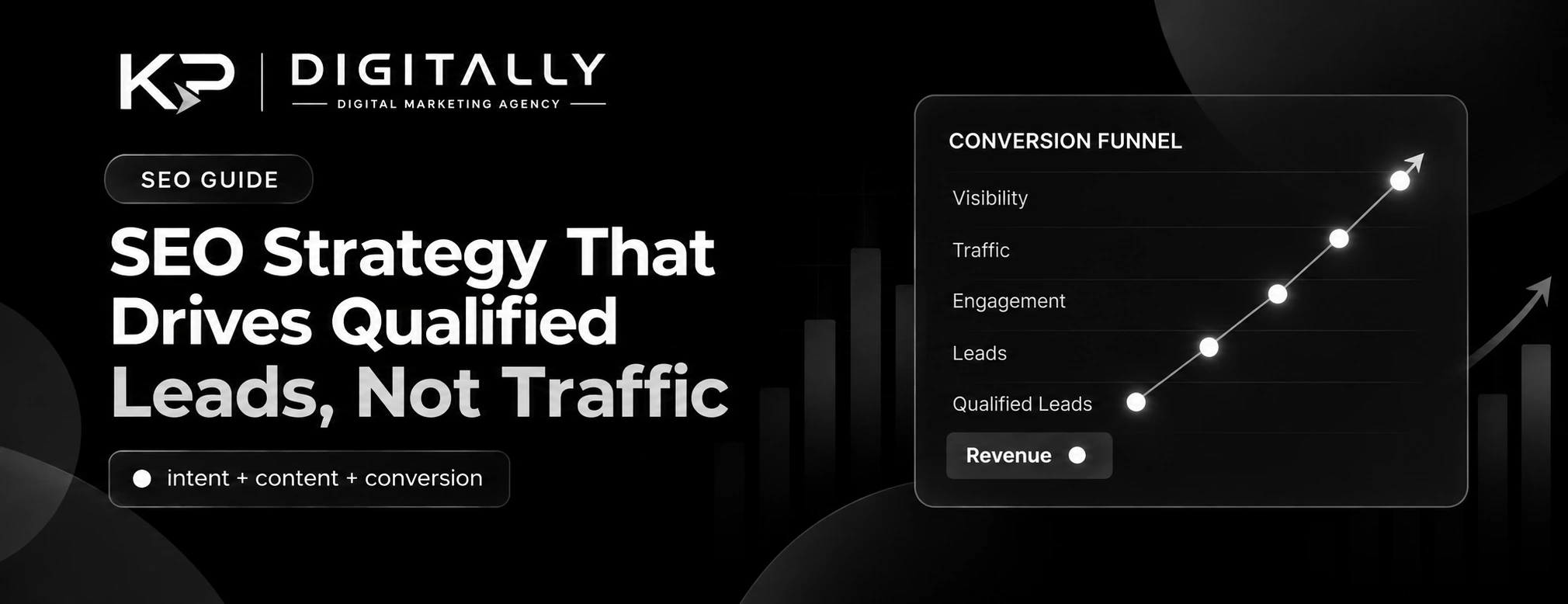
Visibility → Traffic → Engagement → Leads → Qualified Leads → Customers → Revenue
Each stage answers a different question.
Visibility: Are the right pages appearing for relevant searches?
Traffic: Are qualified users clicking through?
Engagement: Are visitors finding the content useful?
Leads: Are visitors taking meaningful actions?
Qualified Leads: Are those leads actually relevant to the business?
Customers: Are leads turning into customers?
Revenue: Is organic search contributing to measurable business growth?
This framework does not make rankings or traffic irrelevant. Instead, it puts those metrics into a larger business context.
For example, a ranking improvement is valuable when it contributes to greater visibility among the right audience. Increased traffic becomes more meaningful when that traffic produces qualified opportunities.
10. Use Search Data to Improve Your SEO Decisions
Search data can reveal more than which pages receive the most clicks.
Businesses can analyze search queries to discover:
- New topics customers are searching for
- Pages gaining or losing visibility
- Queries with strong commercial intent
- Content gaps
- Opportunities for content updates
- Search terms that attract the wrong audience
Regularly reviewing this data can make SEO more responsive and strategic.
For example, if a page receives impressions for several relevant queries but generates few clicks, its title and description may need improvement. If a page attracts significant organic traffic but few conversions, the content, search intent, or conversion path may need to be reviewed.
Google Search Console Insights 2025
The goal is to use search data as an ongoing source of insight rather than treating SEO as a one-time optimization project.
11. Avoid SEO Strategies That Attract the Wrong Traffic
Several common SEO practices can create impressive-looking numbers without generating meaningful business results.
Chasing Search Volume Alone
High-volume keywords are not automatically high-value keywords.
Ignoring Search Intent
A page can rank well and still fail if it does not answer what the searcher actually wants.
Publishing Unrelated Content
Traffic from topics unrelated to the company’s products or services may have little commercial value.
Sending All Traffic to the Homepage
Visitors should be directed to pages that match their specific search and needs.
Using Weak Calls to Action
Even highly relevant visitors may leave if the next step is unclear.
Failing to Track Lead Quality
A large number of inquiries can be misleading if most are irrelevant or unlikely to convert.
Ignoring Existing High-Performing Pages
Businesses sometimes focus entirely on publishing new content while overlooking pages that already attract valuable visitors.
A better approach is to continuously improve the pages that demonstrate both search visibility and business potential.
12. Create an SEO Strategy That Combines Visibility With Conversion
SEO and conversion optimization should not be treated as separate activities.
Search data can reveal what customers care about. Conversion data can reveal which topics and pages actually create business opportunities.
These insights can then improve future SEO decisions.
For businesses looking to strengthen organic visibility and connect search performance with lead generation, a structured SEO strategy can bring together keyword research, technical optimization, content development, internal linking, and conversion-focused improvements.
The key is to make every major SEO activity answer a business question:
Who are we trying to attract?
What are they searching for?
What information do they need?
What page should they visit?
What action should they take?
How will we know whether that action created business value?
When these questions are connected, SEO becomes much more than a traffic acquisition channel.
13. A Practical 90-Day Framework for Lead-Focused SEO
Businesses do not need to rebuild their entire SEO strategy overnight.
A focused 90-day framework can provide a practical starting point.
Days 1–30: Research and Strategy
Begin with:
- Defining the ideal customer profile
- Reviewing existing organic traffic
- Identifying high-value services or products
- Analyzing search intent
- Building a keyword map
- Auditing existing content
- Identifying technical SEO issues
- Reviewing conversion tracking
The objective is to understand where the biggest opportunities exist.
Days 31–60: Optimization and Content
Next:
- Improve important service and product pages
- Create content for high-value search intents
- Strengthen internal linking
- Improve titles and headings
- Address technical SEO problems
- Add relevant conversion elements
- Update outdated high-potential content
Focus on quality and relevance rather than publishing content simply to increase the number of pages.
Days 61–90: Measure and Improve
Finally:
- Review organic conversions
- Identify pages generating qualified leads
- Compare high- and low-intent keywords
- Improve underperforming landing pages
- Expand successful topic clusters
- Update content based on user behavior
- Connect SEO results with sales data where possible
SEO should be treated as an ongoing optimization process rather than a one-time project.
Conclusion
A successful SEO strategy is not defined by how much traffic a website receives. It is defined by whether the website attracts the right audience and helps turn relevant visitors into meaningful business opportunities.
That requires more than keyword rankings.
Businesses need to understand their ideal customers, map content to search intent, prioritize valuable keywords, create useful content, optimize landing pages, strengthen internal linking, and measure conversions beyond simple traffic numbers.
Most importantly, SEO should connect with the broader customer journey.
The goal is simple:
Attract the right searchers. Answer their questions. Build trust. Guide them toward the right solution. Measure what happens next.
When SEO is built around those principles, even modest increases in organic visibility can become more valuable because the focus shifts from attracting more visitors to attracting better-qualified ones.
FAQs
SEO results vary depending on competition, website authority, industry, technical condition, content quality, and the strategy being implemented. Businesses should evaluate progress through both visibility and lead-generation metrics rather than expecting a fixed timeline.
Review the behavior and outcomes of organic visitors. Look at engagement, relevant page visits, form submissions, calls, demo requests, qualified leads, and eventually customer acquisition. Traffic quality matters more than traffic volume alone.
Important metrics include qualified organic traffic, conversion rate, leads, qualified leads, customer acquisition, and revenue from organic search. Rankings, impressions, and clicks are useful supporting indicators but should not be the only measures of success.
Yes. A lower-volume keyword can be highly valuable when it closely matches your product, service, target customer, and buying intent. Relevance and commercial intent can matter more than search volume alone.